

Meet Boop: your personal interactive robot companion designed to help you strengthen your emotional connections with loved ones.
Boop's built-in functions allow you to call, message, and craft meaningful conversations while practicing healthy communication boundaries.
I collaborated with my team (2 designers and 1 product manager) on the full product development cycle of Boop, from the early stages of user research to validation testing.
Project Deliverables
OVERVIEW
Timeline
Oct 2022 - Dec 2022
My Role
UX Researcher & Designer
Tools
Figma, Miro, Google Sheets, Adobe Photoshop and Premiere
Research Methods
Interviews, Surveys, Desk Research
DEFINE
Design Objectives
In our design course, we were prompted to design an experience for people to grow in life together. My team and I bonded over our shared experiences in struggling to connect to loved ones, thus:
Our goal was to design a solution that helps people strengthen emotional connections with loved ones.
Research Objectives
The objectives of our research study were to:
-
Understand how people engage and communicate with loved ones.
-
Identify barriers, if any, to reaching out and connecting with loved ones.
-
Discover new ways that people can create memories remotely with loved ones.
Target Users: We focused on adults (ages 19-65 years old) residing in North America.
DISCOVER
To understand our users, we triangulated 3 research methods: desk research, surveys, and interviews.
Desk Research
I conducted desk research because it is:
-
Cost-effective as our project was not financially funded.
-
Time-efficient as our timeline only allowed for 1 week to conduct user research.
-
Helpful in guiding our design process and building our knowledge of the subject matter.
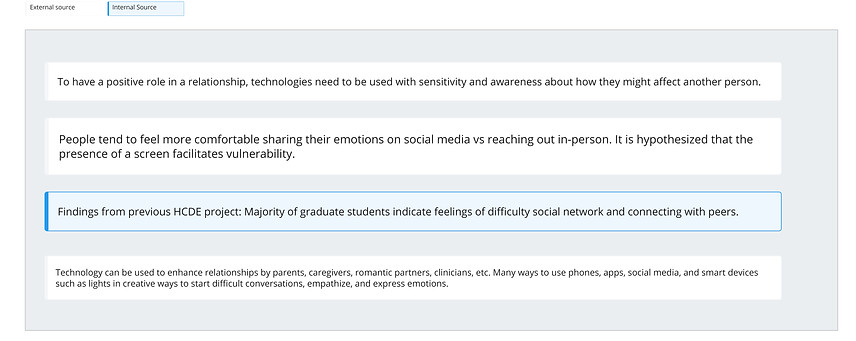
I gathered data from internal sources (previous class projects, class materials) and external sources (peer-reviewed articles, and industry blog posts). My key findings include:
Surveys
I chose to first conduct online surveys (n = 63) because they:
-
Can reach a larger sample and are easily scalable for mass recruitment.
-
Are cost-effective compared to other generative methods.
-
Are effective for gathering general trends in attitudes and behaviors.
Our survey focused on understanding users' perceived satisfaction with their emotional connections and factors that may influence how they communicate with loved ones. We recruited participants by sending out our survey link through HCDE Slack channels and personal networks.
Key findings:
Hover over these!


Interviews
Next, I conducted 3 semi-structured interviews (out of 9) on Zoom to dive deeper into the "whys" and "hows" of users' attitudes and behaviors. I structured the interview questions to focus on the 3 themes we found in our survey findings.
Participant demographics included:
-
8/9 participants were between the ages of 22-35 years.
-
5/9 participants were female; 4/9 were male.
-
8/9 participants did not live with family or relatives.
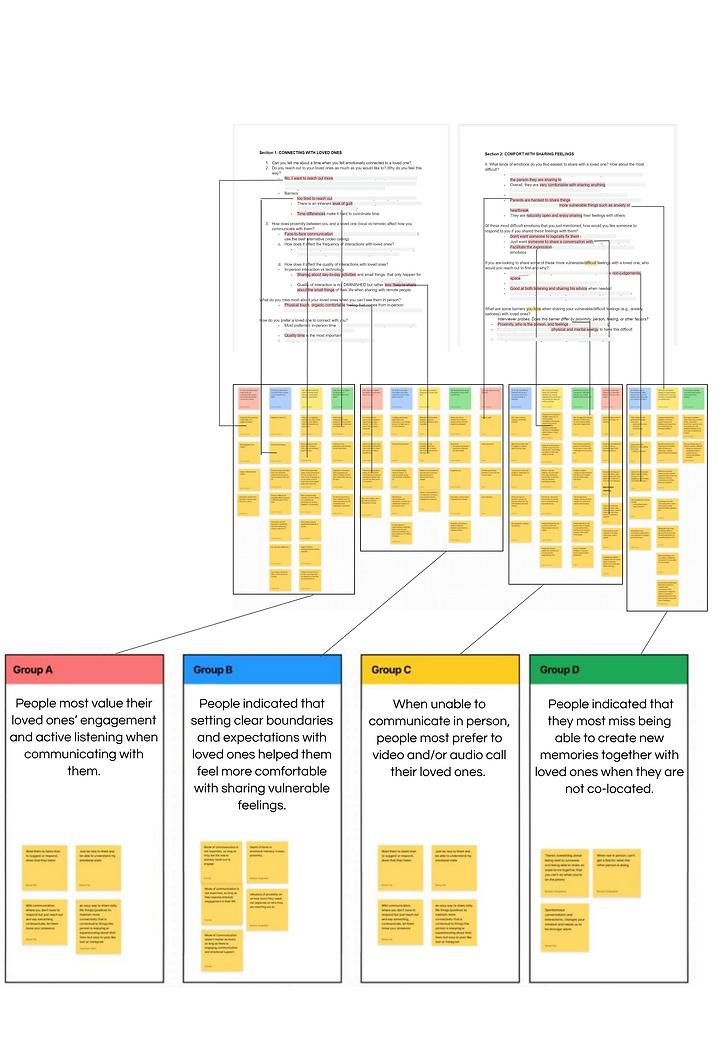
To analyze the interview findings:
Select info has been blurred to protect participants' confidentiality.
Coded interview notes:
I annotated my notes for findings on:
- attitudes and behaviors in reaching
out to loved ones
- pain points and barriers in
connecting with others
1.
Groups of codes:
We grouped common findings across participants together in an affinity map.
2.
Final themes:
We grouped similar ideas
into 4 central themes:
3.
User Requirements
Based on our research findings, we synthesized 5 user requirements to should be addressed in our solution.
Source Research Findings User Requirements
Interviews,
Desk
People most value engagement and active listening with communicating with loved ones.

Minimize Distraction:
Provide a stand-alone platform that reduces user distraction from mobile phones.
Survey,
Interviews
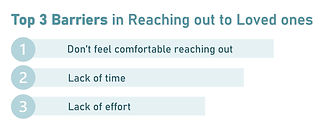
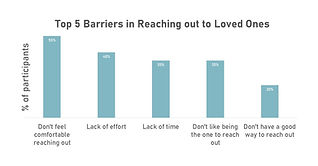
2/3 top barriers to reaching out included lack of time and lack of effort.

Accommodate Schedules:
Help users with scheduling asynchronous and real-time communication.
Interviews
People most miss being able to create new memories when not meeting in-person.

Improve Connection:
Emulate aspects of in-person interaction that users value when engaging with loved ones.
Survey, Interviews,
Desk
38% of participants have difficulty sharing vulnerable feelings; interviewees suggested setting expectations and boundaries.

Set Expectations:
Allow users to establish clear communication boundaries and expectations during calls.
Survey, Interviews
Most people prefer video and/or audio calling with unable to meet in person.

Support Mixed Communication:
Support different communication modes to accommodate users' diverse preferences.
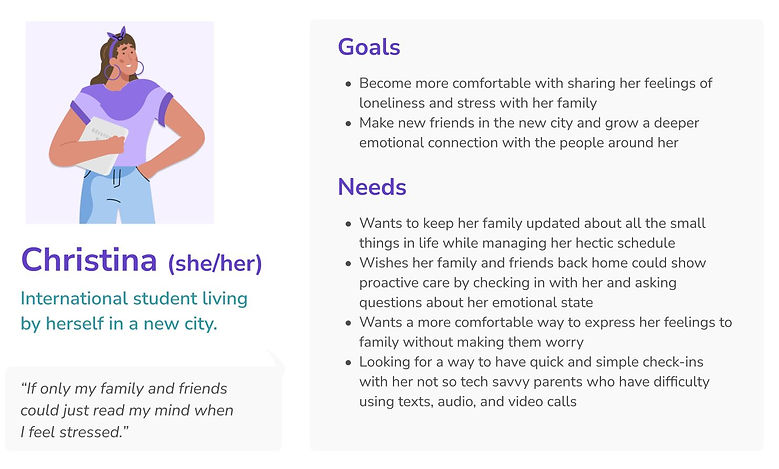
User Persona
We then brought to life our primary user persona based on the key user goals and needs identified in our findings.
DESIGN
Solution Ideation
Guided by our user requirements, our team brainstormed ideas for potential solutions. Here is how our process went:
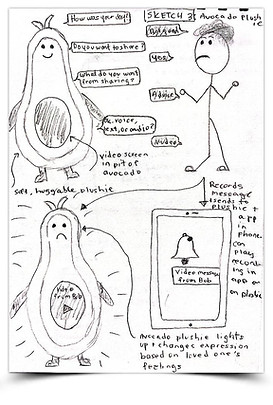
Each member sketched out six ideas and then we collectively discussed the success points and limitations of each idea. We voted on our top three ideas and deliberated on a final solution based on their fit with our design requirements.
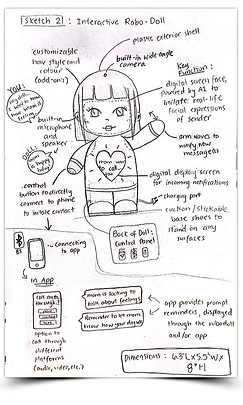
Artist: Connie
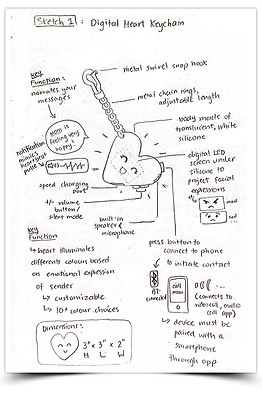
Artist: Connie
Our final decision was the interactive robot doll but we also planned to integrate several desired functionalities from other ideas with this. Jointly, this design solution would meet all our user requirements.
Then, someone said, "This doll is so cute, I want to boop its lil' head!" . . . And just like that, Boop was born!
TOP 3 IDEAS:
Key Features
While our team had lots of ideas for product features, we knew that including it all would harm the user experience. Our challenge now was to identify which features users most want. Based on our research and feedback from course instructors and peers, we determined 5 key features to further develop:
Key Features included:
-
Video and voice call
-
Setting boundaries and expectations
-
Two-way scheduling
-
Group bonding
-
Asychronous messaging


Comments show the feedback from instructors and peers that helped us understand user priorities and identify key features.
Description: Screenshot of our brainstorming ideas on Google Docs.
The User's Story
To humanize our research findings, we developed storyboards and user flows of the key user interactions with the product.
User Storyboard: Video call with set expectations
Artist: Connie
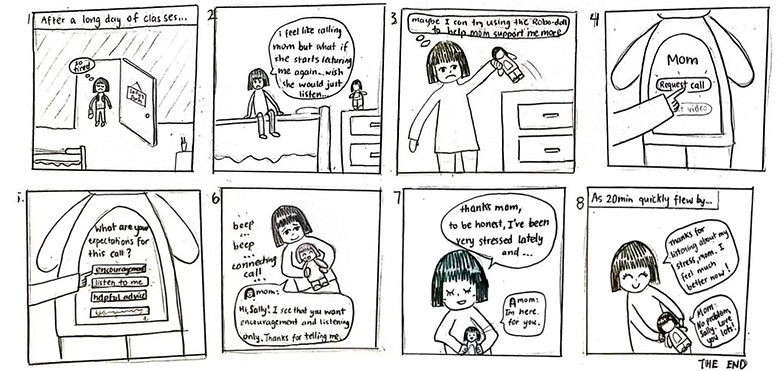
User Flow: Video call

Prototyping
We began by developing clickthrough mid-fidelity prototypes on Figma. Given the time constraints, we chose to prototype only two key functionalities: 1) video call with setting expectations, 2) schedule bonding activity with a group.
Usability Tests
I conducted 3 usability tests on Zoom to evaluate prototype functionality and improve users’ experiences. Participants were instructed to complete three tasks in a think-aloud process, followed by questions on their general impressions.
ANALYSES
1. I annotated my interview transcript for pain points, motivations, and unexpected flows.
2. With another researcher, we identified common trends among users to synthesize into design recommendations and ranked
each recommendation by its degree of severity.
Theme Selection Page (Before)
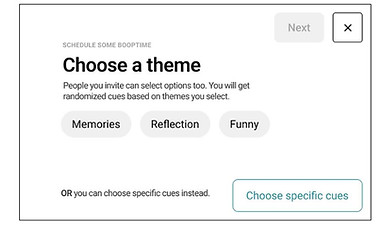
Theme Selection Page (After)
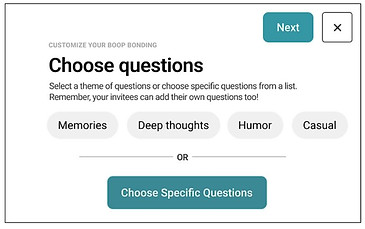
1
2
3
4
Working closely with the designer, we implemented the design recommendations into the prototypes.
1
2
3
4
5
6
5
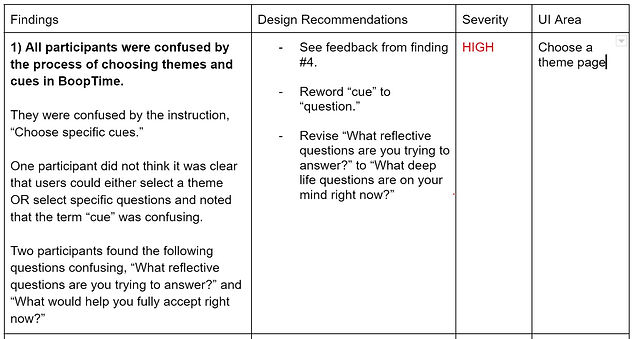
User Feedback
One participant was confused by the instructions as they did not know what a "theme" was. [HIGH]
Two participants did not realize that users could either select a theme or choose specific cues. [HIGH]
Two participants did not realize that invitees can select their own themes or specific cues too. [MED]
One participant was confused about the difference between "Memories" and "Reflections" themes. [LOW]
One participant suggested adding a "casual" theme to facilitate more light-hearted conversation.
One participant suggested having more consistent headings across pages.
1
2
3
4
5
6
Changes Made
Page heading was reworded into "Choose questions" since users thought "theme" was confusing.
Instructions were reworded to explain more clearly to select either a theme or specific questions.
"OR" divider was added between "Choose theme" and "Choose specific questions" for clearer separation.
Instructions were reworded to be more clear so that invitees can select their own questions too.
"Reflections" theme was changed into "Deep thoughts" to reduce ambiguity.
"Schedule Some BoopTime" heading was reworded to "Customize Your Boop Bonding" to keep it consistent across pages.
1
2
3
4
5
6
DELIVER
Final Solution
PHYSICAL FEATURES
We developed Boop's physical features with the intent to deliver an amiable and fun-loving experience for a diverse range of users. We also considered that an aesthetically "cute" design would promote users to foster emotional connections with their Boop companion.
IN-SCREEN FEATURES

Digital LCD Screen
(in-screen functions
appear here)
ON/OFF Button
Small LED bulb
Battery Compartment
USB-C Charging Port
LED Lght Ring
Built-in camera and microphone
Boop Call
Make and receive calls (video or audio) directly from your Boop to your loved ones' Boops. There is also an option that helps you and your loved ones establish boundaries and expectations.
Met Requirements:


Boop Message
Send and receive asynchronous video or audio messages to your loved ones’ Boops. Due to time constraints, this functionality was not fully designed.
Met Requirements:


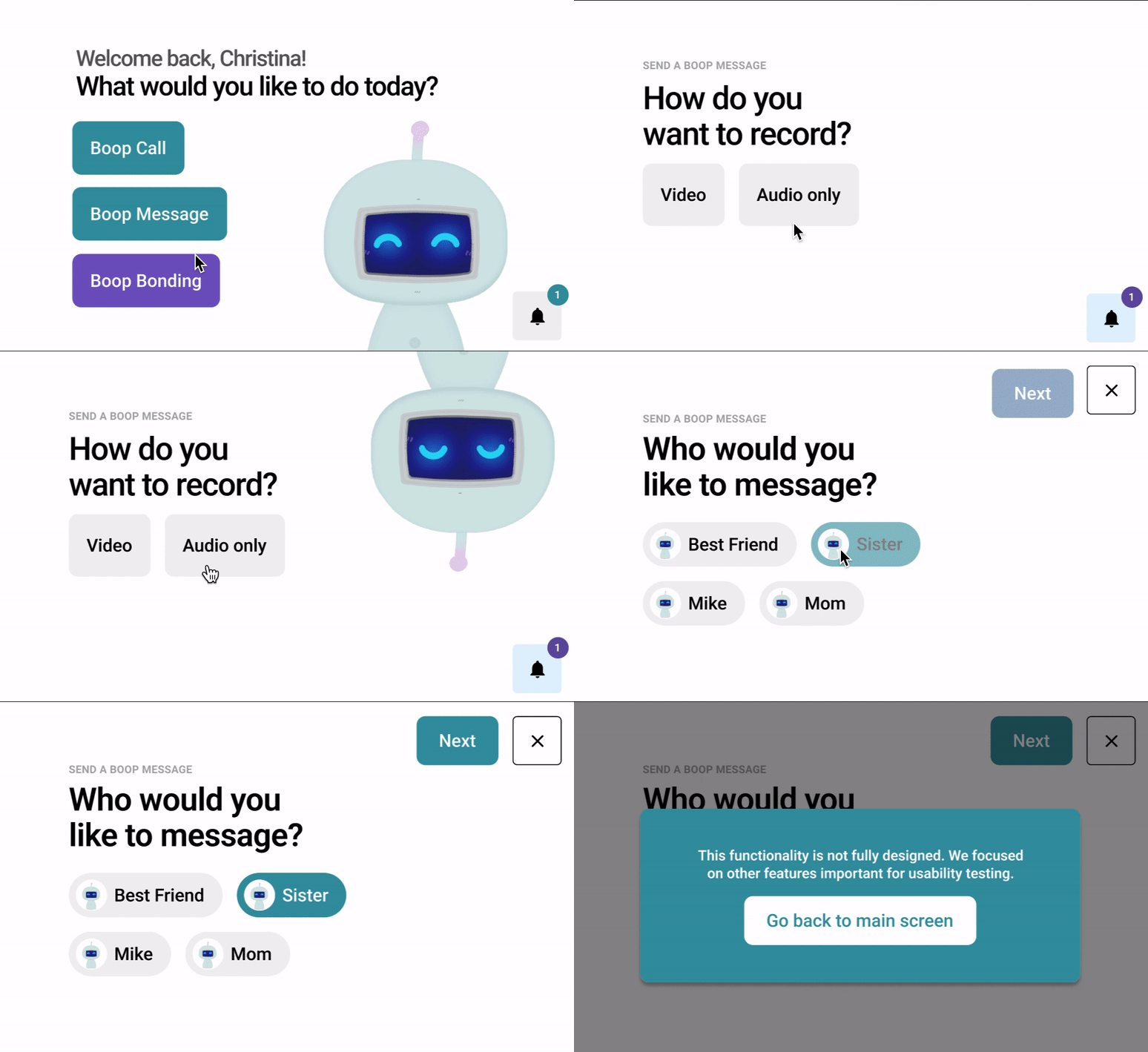
Boop Bonding
Create conversation guided by inquisitive questions that have been curated to help deepen your emotional connection with loved ones. You and invitees can select questions from a theme deck or customize your own set.
Met Requirements:

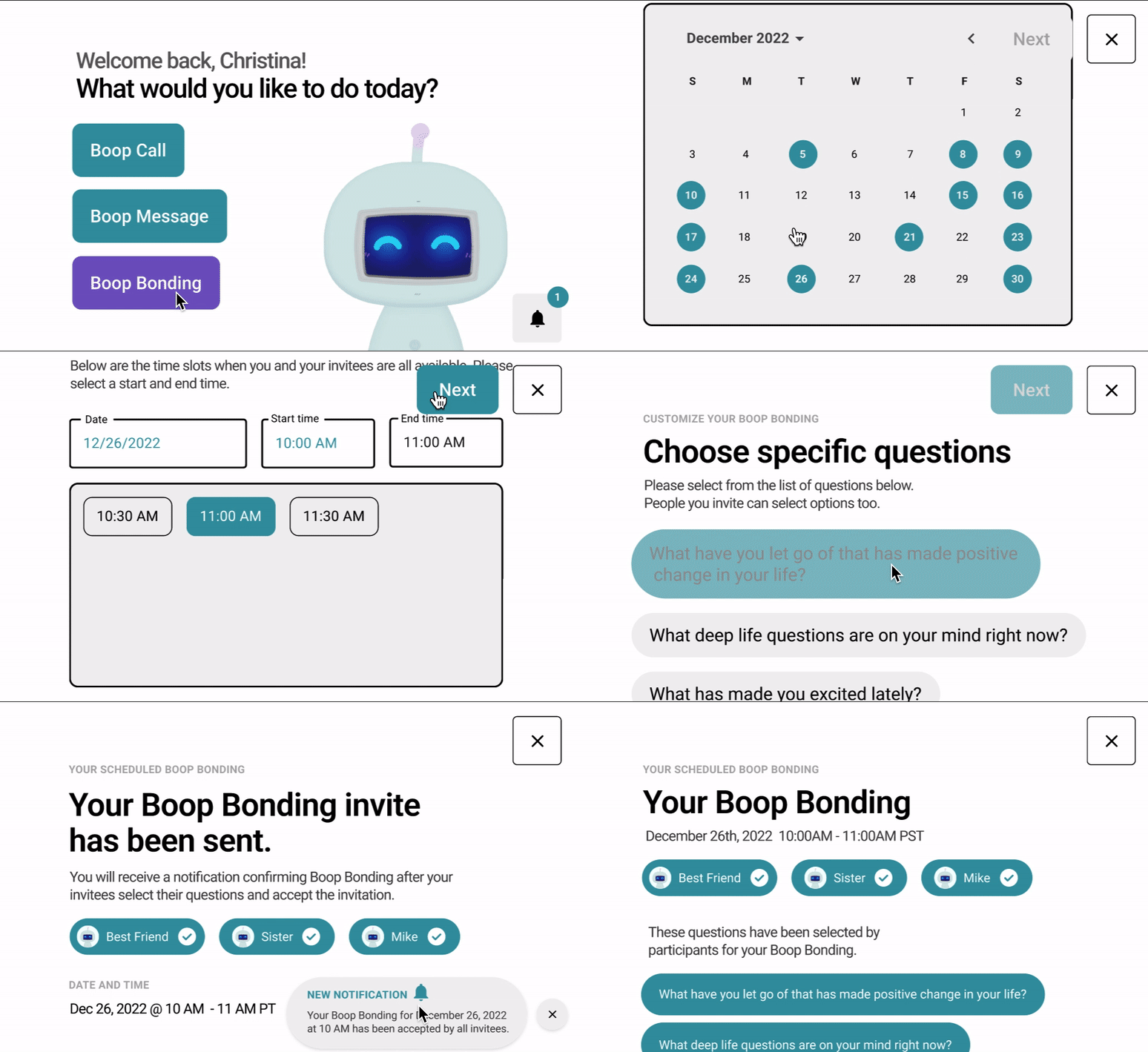
At the culmination of this project, we presented our design solution at the HCDE Design Showcase. Our final deliverable included a demo video showcasing our product and its features to fellow peers and instructors.
User Impact
While we did not have time to collect quantifiable impact data, Boop received many positive remarks at the showcase. Several peer users indicated an interest in using our product to better their connections with loved ones:
"I really like the feature for establishing your expectations and boundaries before the call. Whenever I call my parents, I feel so stressed because they bring up topics that make me uncomfortable to talk about such as marriage or finding a job."
- Peer User
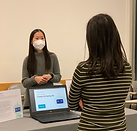
"In the Boop Bonding feature, I think the scheduling feature would be really useful. My friends and I always have a hard time coordinating our schedules to have a call so I would definitely use this feature a lot. I would also like to see this function in the video calling section too."
- Peer User
REFLECT
If I could redo our project with what I know now, I would have...
-
Performed cognitive walkthroughs of all prototypes. Glancing back, there are many errors in plain sight that could have been addressed this way. It is also time-efficient and cost-effective which aligns with our project constraints.
-
Restructured our thematic analysis process. During the annotation of codes, our group members did not establish a consensus on how to code our interview notes, likely resulting in poor inter-rater reliability and high subjectivity to personal cognitive biases.
If our project allowed for more time, I would have...
-
Performed personal inventories for user research to understand users' values and beliefs on emotional connection. This empathy-driven method fits well with our research question to understand how people can strengthen their connections with loved ones but would require more time for recruitment and analyses.
-
Conducted 2+ more cohorts of usability tests on all of our in-screen prototypes, each with 5-8 participants.
-
Recruited a more representative sample of our intended user pool. Our survey and interview participants were predominantly in their 20s and students from the HCDE program, which does not represent our intended users between the ages of 19-65 years old and beyond the student population.
Lessons I Learned
Embrace uncertainty in the design process.
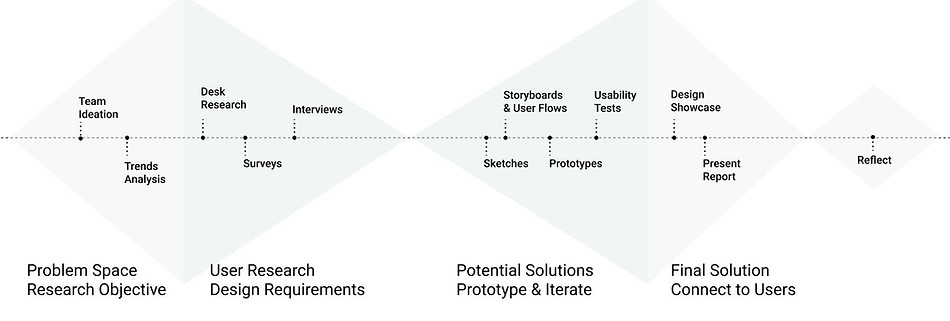
I learned about the importance of accepting that the design process often does not occur how you intend it to. Despite trying to adhere to the Double Diamond framework, our group faced much uncertainty when dealing with obstacles in the process. For example, when creating the initial physical design of Boop one week before the project timeline, we received user feedback that it was not gender-inclusive and thus, we redesigned all the physical features of the product to be more inclusive. While this took several hours, we are glad to have valued our users' needs first.
Practice gratitude throughout the process.
I want to recognize that this project could not have been done without the support of our instructors, peers, and participants. For our participants, I acknowledge that emotions and relationships are not always comfortable discussion topics so I wanted to prioritize building rapport with participants and fostering a safe space to discuss their genuine feelings. What I found to be most helpful for this was conveying to participants how much I appreciated all their contributions and that their well-being is always my top priority even before and after the interview process.